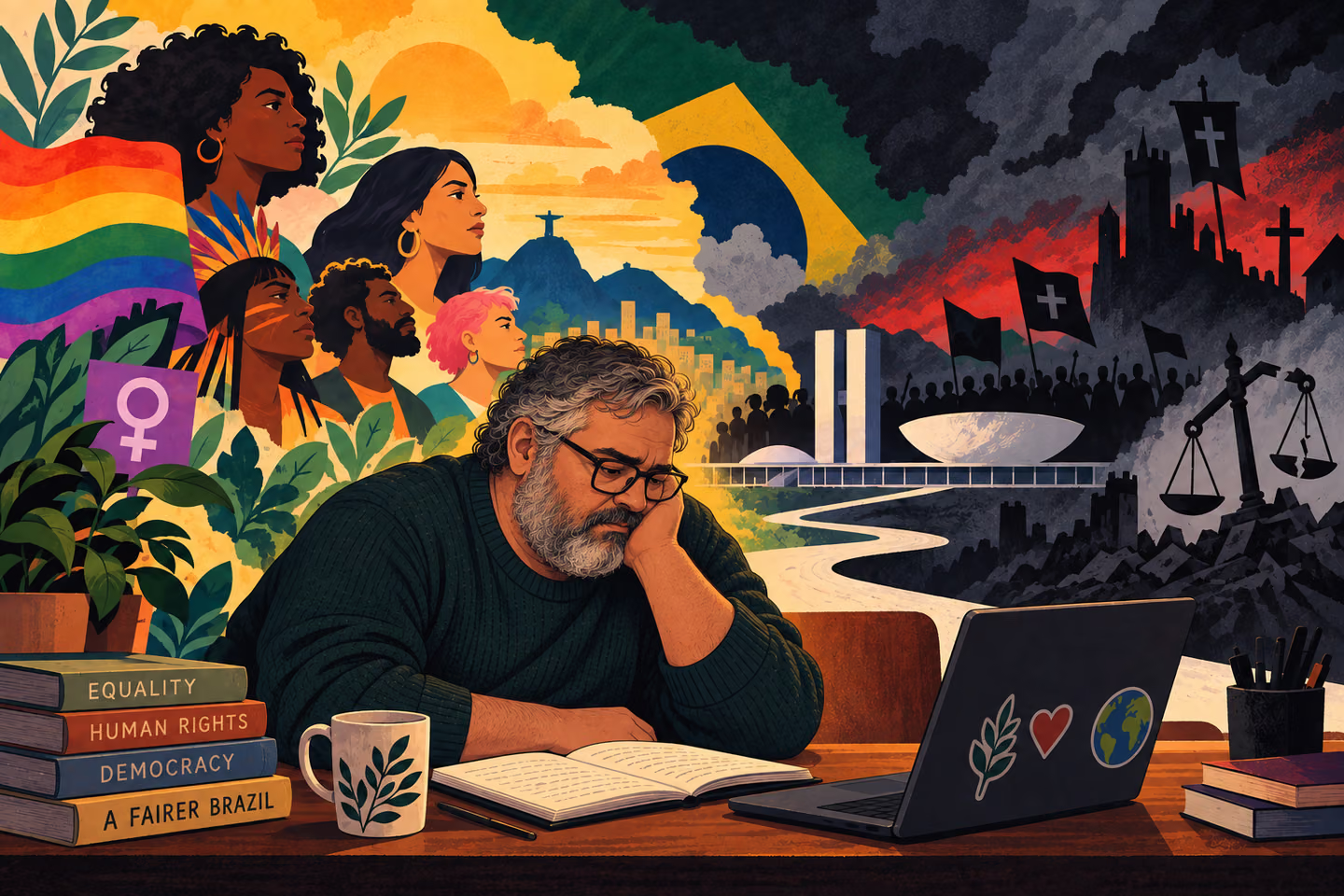
What Flavio Bolsonaro's Election Takes Away From Us
I have written here many times that I blog because writing helps me think. Lately, however, I have found myself doing the opposite: trying not to think too hard about something, because thinking about it means admitting that it is real. Flavio Bolsonaro’s election as president of Brazil is one of those things.
I know we don’t usually talk politics here, and I have no intention of turning this blog into a place where I tell people who to vote for. This time I’m here to write about what happens when a country decides, through the ballot box, that some of the progress we have made was a mistake — that is what I am trying to understand.
It is not just about one man
Whenever a far-right politician wins an election, people like to focus on the candidate’s personality. That is understandable, but it is also incomplete. Flavio Bolsonaro did not appear out of nowhere; he is the result of something that has been growing for years: the idea that equality is a kind of unfairness, that protecting minorities is an attack on “normal” people, that a society should have a single correct way to live, and that the state’s job is to enforce it.
The problem is not that he exists, but that there are enough people who looked at his ideas and decided they represented a Brazil they wanted.
Progress is more fragile than we like to admit
It is easy to forget how recent some rights are. We talk about LGBTQ+ protections, indigenous rights, women’s rights, anti-racism policies, and environmental regulations as if they were part of the furniture, but they are not. They are recent, fragile, and were never truly accepted by everyone: they were achieved through conflict, not consensus.
Electing someone whose political identity is built around rolling them back does not magically erase them, of course. But it sends a very clear message: these rights are not secure. They can be contested, weakened, or made so difficult to enforce that they exist mostly on paper. And when the president himself treats equality as an optional luxury, that message reaches everywhere.
Going back to the Middle Ages?
When people say an election is taking us back to the Middle Ages, they are obviously not talking about bringing back feudalism. They are talking about a specific way of organizing society: one in which there is a single official truth, one correct way to live, and everyone outside it deserves to be punished.
The Brazilian far right has been remarkably consistent about this: the idea that the government should not interfere with what happens in a woman’s body disappears; the idea that LGBT people deserve the same legal protections as everyone else is treated as an imposition; religious or moral arguments are brought back into civil law as if separation between them had been an error. And probably the worst: society is divided into people who behave correctly and people who need to be corrected and punished.
That is what makes this election feel so much bigger than a normal political defeat. It is not just a change of economic policy, but the possibility that the state will be actively used to push back against the idea that everyone deserves equal dignity.
Why I still write
I have mentioned before that keeping a blog in 2026 sometimes feels like a strange, almost old-fashioned thing to do. But moments like this are exactly when having a place to write matters. Not because my opinion is so important that the world needs to hear it, but because writing is how I make sense of things.
I don’t know what the next few years will bring. I suspect they will be difficult for anyone who cares about equality, civil rights, and the idea that the state should protect people instead of choosing which ones are worth protecting. I also know that despair is not a very useful long-term plan, even if it is a perfectly understandable short-term reaction.
So I write because I refuse to pretend that this doesn’t matter; because remaining silent about things that scare me is an excellent way to make them even scarier; and because I still believe that small voices matter, even when they seem to be shouting into the void.
Maybe my little blog won’t change anything — that is probably true. But changing the world was never the only reason to write. Sometimes writing is just how we refuse to disappear.