Did We Really Need to Invent Journaling?
I’ve always enjoyed writing. Back when owning a personal computer was still a distant dream, I was constantly writing in notebooks of all shapes and sizes. I wrote down anything that interested me, as well as all the things I was supposed to write down: reminders, class notes, meeting notes, etc.
And then, in 2026, long after all the excitement about blogs had died down, I discovered that apparently there is an activity on social media called journalling, complete with methods, materials, techniques, influencers, and an entire aesthetic built around it.
And thus my new hobby was born: broke-ass journalling.
In other words, in order to criticize people for appropriating the idea of writing in a notebook, I’m now writing about my own idea of how to write in a notebook. Something like that.
The idea of recording things in a notebook is, obviously, much older than the word journalling. For centuries, notebooks served a mixture of purposes that today we’d probably try to separate into different apps. So-called commonplace books, for example, collected excerpts from books, quotations, personal observations, and whatever other information their owners thought worth keeping. Some were carefully organized by subject; others, not so much.
It also didn’t take us long to discover that important events and mundane details coexist perfectly well in the same notebook. One famous example is Samuel Pepys, an English civil servant who kept a diary from 1660 to 1669. His account covers major historical events in seventeenth-century England, but also records work, social life, music, personal relationships (including those), and other bits of everyday life. Today, his diary is a valuable historical source precisely because it preserved not only the major events themselves, but the experience of someone who was simply living his life while they happened.
And, before we feel like blaming Instagram for everything, it’s worth remembering that the industry figured out very early on that you could sell people a structure for this activity. The first pre-printed diaries appeared in England in the eighteenth century; research from the University of Oxford identifies 1748 as a milestone in the emergence of diaries already divided into spaces and categories to be filled in. By the nineteenth century, an enormous variety of them was available for sale, combining calendars and useful information with spaces for appointments, financial transactions, weather, food, and whatever else might fit.
So the influencer who shows up today to teach you the correct method for organizing your life in a notebook didn’t invent that either. Somewhere in Victorian England, there was probably a version of him wearing a top hat.
Instagram didn’t invent journalling, then. What it did was add something that significantly changed the nature of the activity: an audience, which naturally favors a more sophisticated and visually interesting version of it. That’s simply the nature of Instagram.
I happen to like notebooks and pens very much myself. I love writing with a fountain pen on heavy dotted paper, but I also enjoy writing with a ballpoint pen or a pencil on whatever piece of paper happens to be within reach. The Instagram aesthetic isn’t any more journalling than my little crappy notebook where I dump the ideas I don’t want simmering inside my head. In fact, until today I didn’t even use the word journalling for what I think is better described as “free writing in a crappy little notebook.”
And this is where broke-ass journalling comes in. Not as an argument that good notebooks are pointless, expensive pens are a waste of money, or that there’s some sort of moral superiority in writing on the back of your electricity bill. If you want to spend a fortune on a Japanese notebook and several more hours decorating every page with stickers, great. Maybe that’s precisely the part of the activity that gives you pleasure.
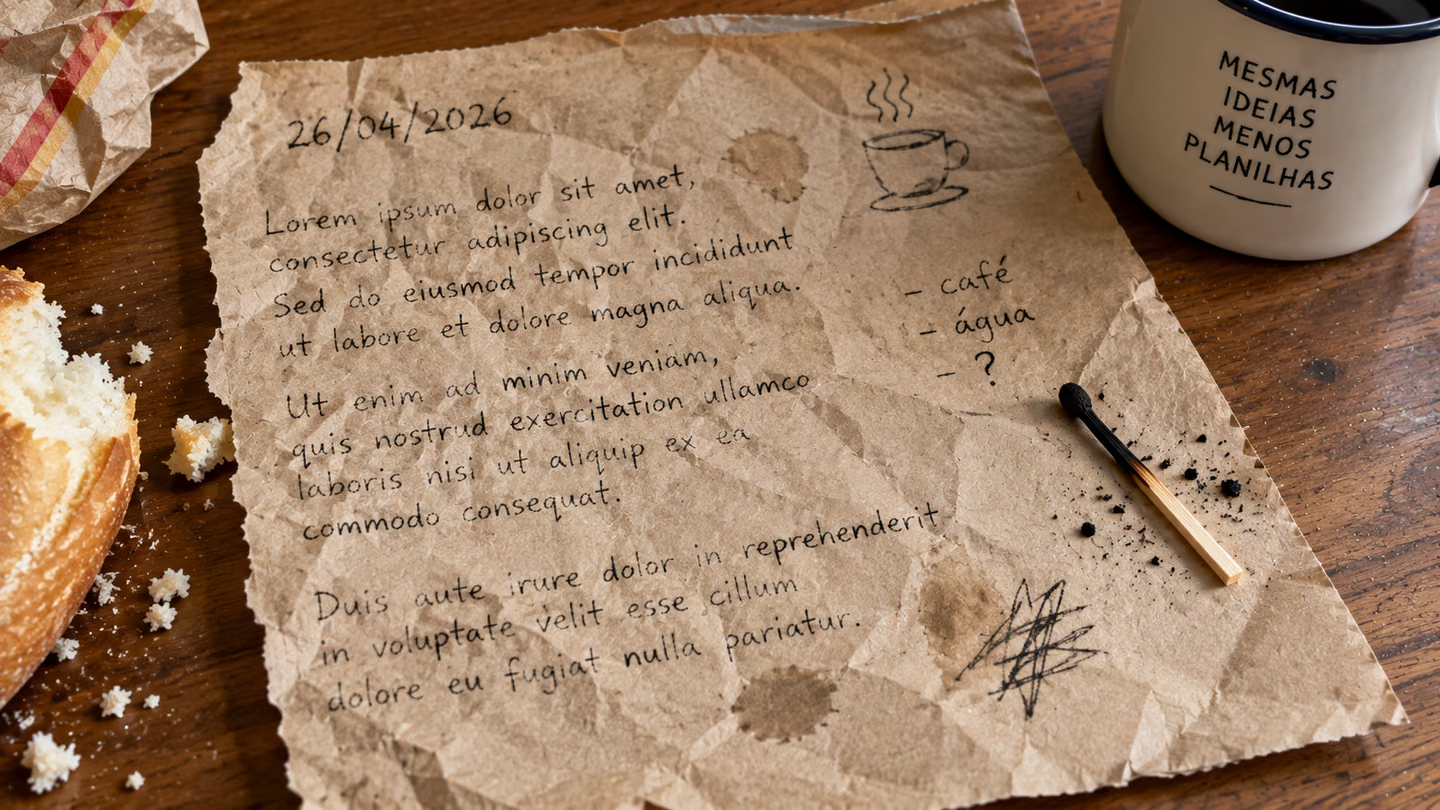
The minimum requirements for writing remain ridiculously low. A paper takeout bag and a burnt matchstick will do. I just prefer my less-than-three-dollar Black Warrior (that’s not a metaphor), a Chinese fountain pen that gives me enormous pleasure to write with. Better materials can make writing more enjoyable; they just don’t necessarily have to be expensive. They can be, but they don’t have to be.
So, after complaining that people have turned the simple act of writing in a notebook into a hobby with a name, methods, products, and influencers, I am now making my own contribution to the problem and inaugurating a new category on this blog: Broke-Ass Journalling. In it, I intend to talk about pens, inks, paper, notebooks and, inevitably, offer my own opinions on how to write in a notebook.
Somewhere, the Victorian journalling influencer in the top hat is proud of me.
Sources and further reading
- Harvard Library — The Fragment and the Whole, on commonplace books.
- University of Leicester — Reimagining the Restoration: Samuel Pepys’s Diary and Popular History for the 21st Century.
- Hazel Tubman, University of Oxford — The First Pre-Printed Diaries: Origins, Development and Uses of an Information Genre, 1700–1850.
- University of Oxford — Pre-Printed Diaries and Almanacs: An Aid to Managing the Diseases of Modern Life.