A Pen Is Not Just a Pen
Table of contents
Recently, in the previous post in this series, I said that to practice journaling you need only two things: something to write on and something to write with. For the sake of simplicity: paper and pen. It sounds simple — and it is. The real problem begins when you make the mistake of becoming a little more interested in the second part of that system.
For most of my life, a pen was simply a pen. Some were better, some were worse; some wrote smoothly, while others seemed to require me to try to punch through the paper. There was the Bic everybody knows, those gel pens I thought were pretty and, somewhere very far removed from my reality, fountain pens, which I associated with important people signing documents.
It turns out there are several different ways to make a pen put ink on paper. Ballpoints, rollerballs, gel pens, felt-tip pens, fountain pens — they all essentially do the same job, but use very different mechanisms and inks to do it. And that changes not only how writing feels, but also much more practical things, such as the kind of paper you can use, how much pressure you need to apply, and how much money you are going to spend.
Ballpoint pen
If you grew up in Brazil, there is a good chance that the first image that comes to mind when someone says “pen” is something like a Bic Cristal. It is so common that it is easy to forget there is a reasonably clever mechanism inside that tiny tip.
To save myself some time, I asked ChatGPT to write two paragraphs about this writing instrument:
The name ballpoint comes from the small ball at the tip of the pen. On one side of it is the ink stored in the tube; on the other, the paper. As the ball rolls across the surface, it picks up ink from inside the pen and transfers it to the paper on the outside. It is basically a tiny bearing acting as an intermediary between the reservoir and whatever you are writing on.
The ink used in traditional ballpoint pens is quite viscous, usually oil-based. This has some enormous advantages: it does not evaporate easily inside the pen, dries relatively quickly once applied, and works reasonably well even on questionable paper. A ballpoint can also sit forgotten in a drawer for quite a long time and, barring some bad luck, start writing again when you need it.
That viscosity also helps explain something I had never really stopped to think about: we normally need to apply some pressure when writing with a ballpoint. The ball has to roll against the paper to transfer that relatively thick ink. Depending on the pen, this can mean a very comfortable writing experience or that familiar sensation of practically carving the words into the page — specially for someone like me, who spent decades accustomed to writing with a heavy hand.
Naturally, “ballpoint” is a huge category. There are everything from cheap Bics to very sophisticated models, with considerable differences in ink formulation, ball size, the amount of ink deposited and, consequently, the writing experience.
But the basic principle is the same: a small ball rotates at the tip of the pen and carries relatively viscous ink from the reservoir to the paper. It is simple, cheap, reliable, and works so well that, for many people, it became simply the pen.
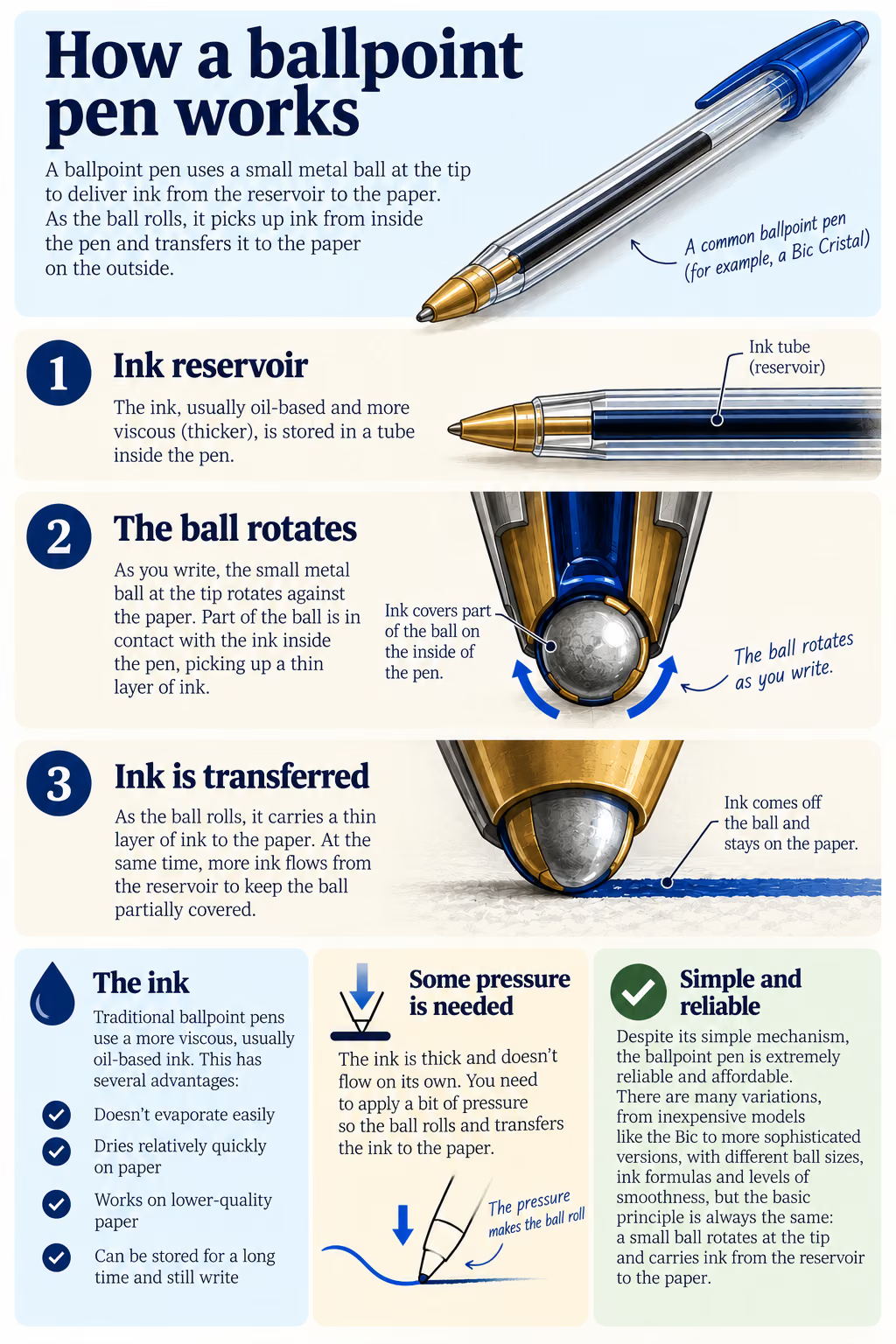
The infographic above was also generated by ChatGPT.
Rollerball pen
At first glance, a rollerball may look like nothing more than a ballpoint with a fancier name. And that is not an entirely wrong impression, since both use essentially the same mechanical principle: a small ball rotates at the tip of the pen and transfers ink to the paper.
The big difference is the ink. While a traditional ballpoint uses a very viscous, usually oil-based ink, a rollerball uses a much more fluid ink, normally water-based. This makes an enormous difference in the way the pen writes.
Because the ink flows much more easily, you need to apply far less pressure to the paper. Instead of pressing the ball hard enough to make it carry that thick ballpoint ink, you can almost just guide the rollerball across the page. The result is usually a more continuous, intense, and smooth line.
Naturally, there is no free lunch. More liquid ink tends to be absorbed more easily by the fibres of the paper. Depending on the combination of pen, ink, and paper, this can cause feathering — when the ink spreads along the fibres and makes the edges of the line look like tiny branches — or even bleeding, when it goes through the page. A rollerball also tends to use ink faster than a ballpoint.
There is another very visible consequence of this difference: many rollerballs need a cap. Because the ink contains more water and dries more easily when exposed to air, leaving the tip uncovered for too long can make the pen stop writing until the ink starts flowing again.
So, although ballpoints and rollerballs both use a small ball to put ink on paper, the experience can be quite different. The ballpoint prioritises durability, reliability and tolerance for almost any kind of paper; the rollerball trades some of that practicality for a more fluid writing experience that requires less pressure.
In a way, it is the same mechanical trick being used to deal with a completely different ink.
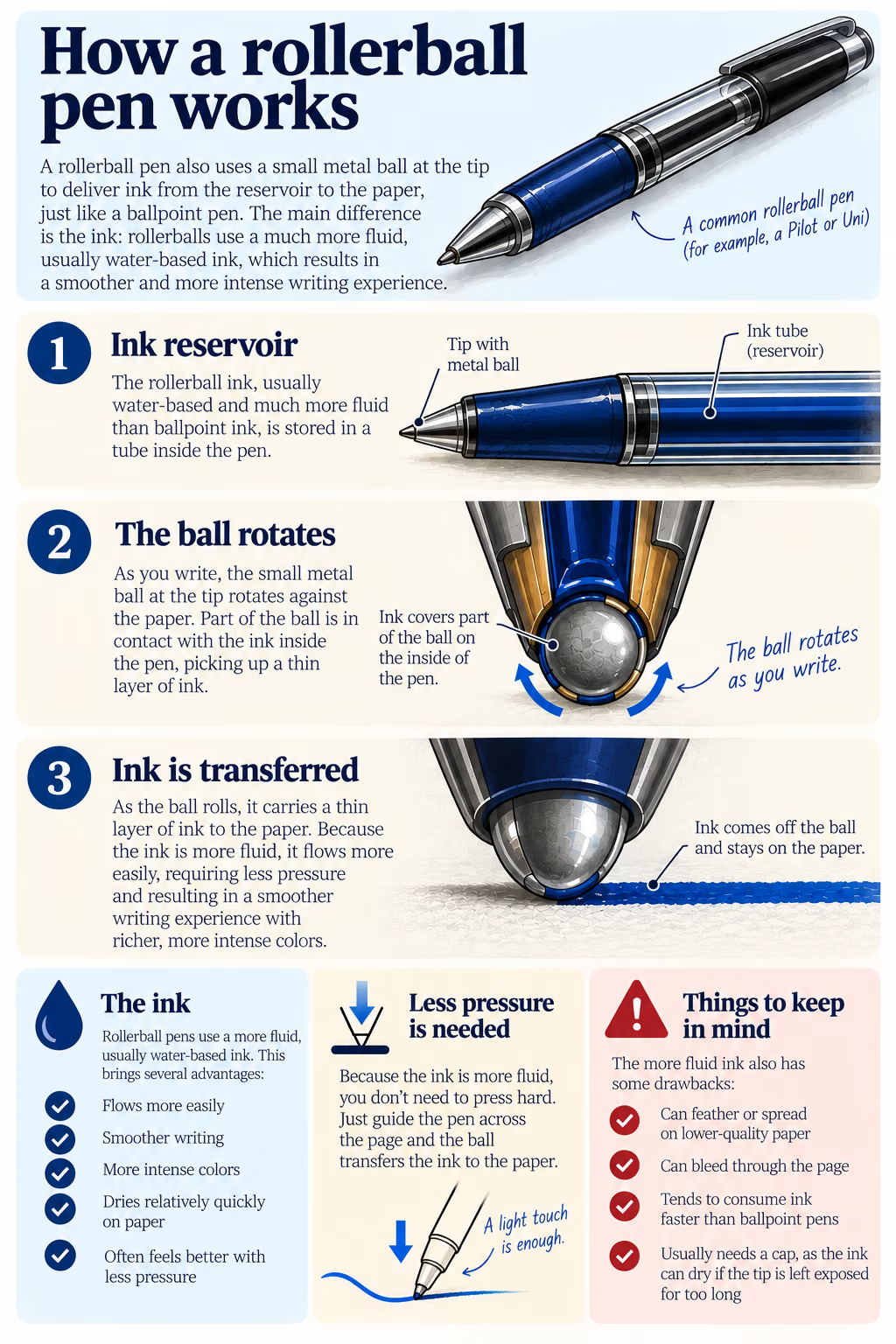
Once again, the infographic was generated very competently by ChatGPT.
Gel pen
Both the ballpoint and the rollerball use a small ball to carry ink to the paper; a gel pen works the same way.
Mechanically, a gel pen belongs to the same family: there is a small ball at the tip that rotates as we write and carries ink from inside the pen to the paper. What changes, once again, is mainly what is being carried.
Gel ink is generally water-based, but contains pigments suspended in a gel-like substance. At rest, it is relatively thick; when the ball begins to rotate during writing, the movement helps the ink flow. Once deposited on the paper, it goes back to behaving like a thicker substance.
This behaviour makes for an interesting combination of characteristics. A gel pen usually requires less pressure than a traditional ballpoint and can provide a very smooth writing experience, while its ink does not have to be as liquid as a rollerball’s.
The pigments also help explain one of the most obvious characteristics of gel pens: the enormous variety of colours. Because the ink can carry pigments instead of relying only on dissolved dyes, it is possible to produce very intense, opaque, metallic, and fluorescent colours, and even inks that show up on dark paper.
But, again, there is no free lunch. Gel pens normally use ink faster than ballpoints, and some inks take a little longer to dry on the paper, which can result in smudging — especially if you drag your hand over what you have just written, or if you are left-handed. Depending on the pen and paper, there can also be bleeding, or ink may build up at certain points in the line.
And then there is that classic experience of picking up a gel pen that apparently still has half a tube of ink and discovering that it has simply decided not to write. Air bubbles, dried ink at the tip, or interruptions in the flow can make a pen that looks perfectly full behave as if it has reached the end of its life.
Even so, gel pens occupy a very interesting middle ground. They retain the practicality of a ball-based pen, require relatively little pressure, and offer a variety of colours and an intensity of line that a traditional ballpoint has a hard time reproducing.
And all because someone decided to put ink with the consistency of gel behind that same little ball.
Felt-tip pens and fineliners
So far, every pen we have looked at has had one thing in common: a small ball rotating at the tip and carrying ink to the paper. With felt-tip pens, we can finally get rid of the little ball.
Instead, these pens use a tip made of porous material — usually compressed synthetic fibres — which receive the ink stored inside the pen and carries it to the paper by capillary action. In other words, the tip itself remains supplied with ink and deposits it as it comes into contact with the surface.
If you have ever used those felt-tip colouring pens at school, you already know the principle. It is a huge family, ranging from thick markers to instruments with extremely fine tips used for technical drawing, illustration and writing.
That is where fineliners come in.
The term is used for pens with very fine porous tips, usually sold in specific widths such as 0.2, 0.4 or 0.8 mm. Brands such as Stabilo, Staedtler and Sakura helped make this kind of pen quite popular for both drawing and writing, and they are not hard to find among products marketed specifically for journaling.
The experience is quite different from writing with a ballpoint. Since there is no ball that needs to be pressed and rotated, a porous tip normally requires very little force. The flow tends to be uniform and predictable, and the line width can be very consistent — characteristics that are particularly useful for people who draw, make diagrams or simply like well-defined writing.
On the other hand, the tip is also one of the most vulnerable parts of the pen. Pressing too hard can deform or wear down the fibres, permanently changing the width and quality of the line. For someone accustomed to trying to punch through the paper with a ballpoint, it may be necessary to relearn how to write with a little less brutality.
The ink, which is normally quite fluid, can also be demanding about paper. Depending on the pen, you may encounter the same feathering and bleeding problems that appear with other liquid inks. And because the tip is directly exposed to the air when uncapped, leaving one of these pens open for too long is an excellent way to discover what the cap is for.
Perhaps the most interesting characteristic of porous tips is precisely their simplicity: there is no ball, nib or any other moving mechanism at the tip. The ink simply travels through a porous material until it reaches the paper.
After three different types of pen based on a tiny metal ball, it is a surprisingly radical change for something that continues to do exactly the same thing: put ink on a sheet of paper.
Fountain pen
And finally, we arrive at the reason I am writing all of this.
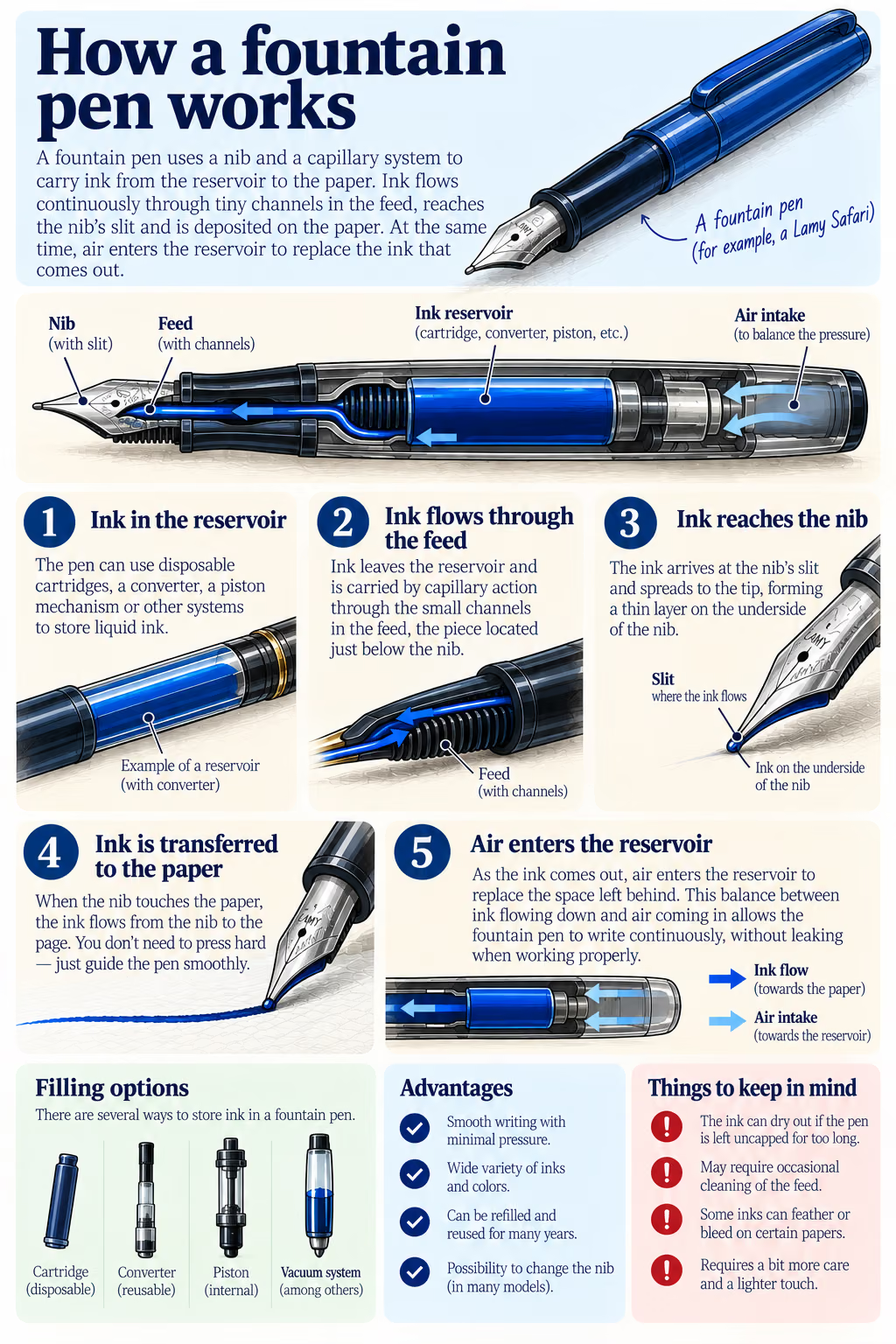
A fountain pen is quite different from all the types we have looked at so far. There is no rotating ball, nor a fibre tip absorbing ink. In its place is a nib, usually made of steel or gold, continuously supplied with liquid ink stored inside the pen.
The mechanism seems almost magical until you discover that it relies mainly on something quite mundane: capillary action. Ink leaves the reservoir and travels through tiny channels in the feed, the part located immediately below the nib. From there, it reaches a narrow slit down the centre of the nib and continues towards the tip. When the tip touches the paper, the ink continues on its way and is deposited on the surface.
At the same time, air has to enter the reservoir to replace the space left by the ink that has come out. This balance between ink flowing down and air coming in is what allows a fountain pen to write continuously without simply dumping the entire contents of the reservoir onto the paper — at least when everything is working as it should.
This is also why writing with a fountain pen should not require pressure. The ink is already reaching the tip on its own; your hand basically just needs to guide the nib across the paper. For me, discovering this meant unlearning a few decades of experience trying to make ballpoints write through brute force.
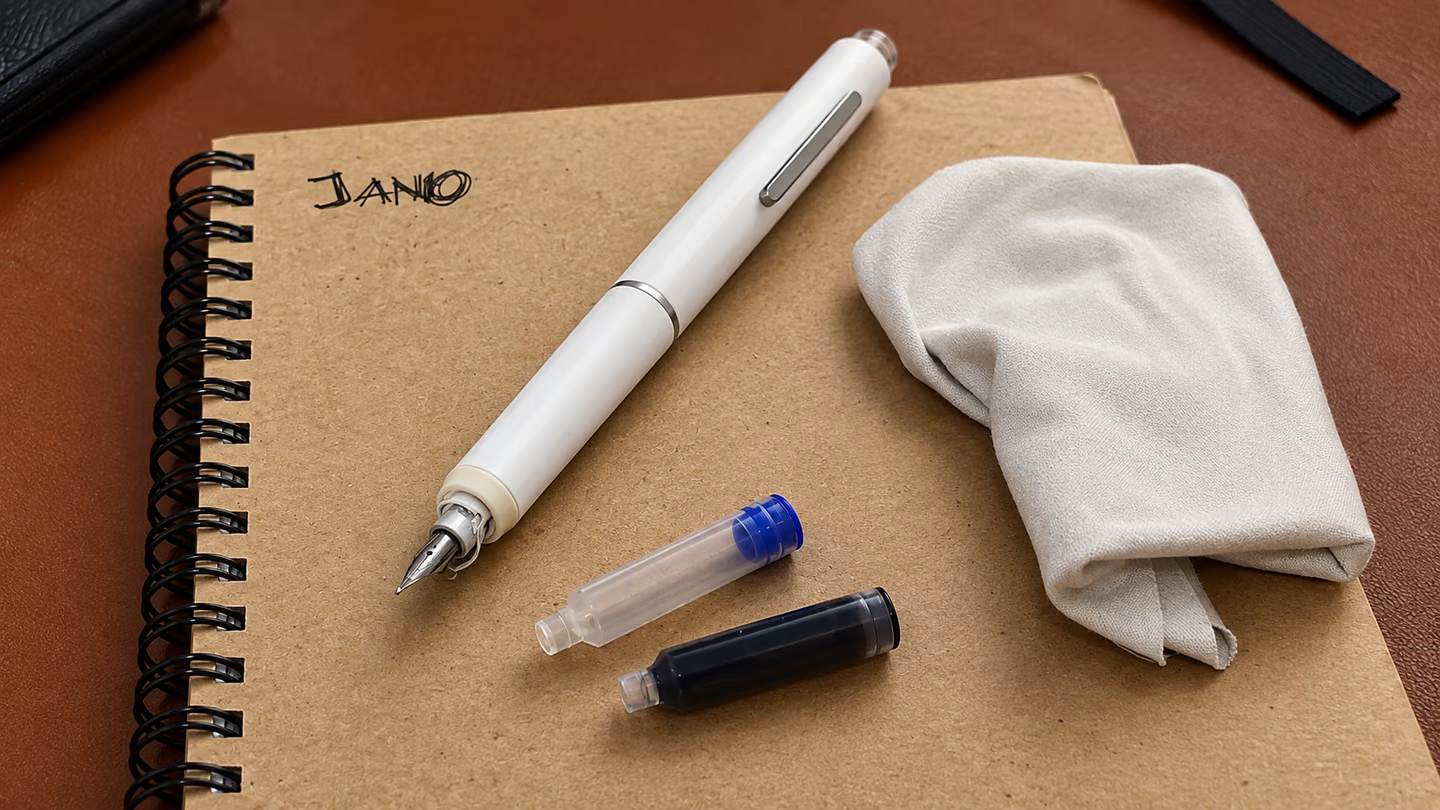
The reservoir itself can take several forms. Some pens use disposable cartridges; others use converters, which allow you to fill them with ink from a bottle. There are also pens with built-in filling mechanisms, such as pistons and vacuum systems, as well as models in which the body of the pen itself serves as the reservoir.
And this is where one of the major differences between a fountain pen and practically all the previous types begins: you do not necessarily have to throw away one load of ink and buy another identical one. You can empty the pen, wash it and fill it again with another ink — from another brand, in another colour and with completely different characteristics.
That freedom also comes at a price.
Fountain pens require some care. Ink can dry inside the pen, the feed may need cleaning, some inks behave better than others, and paper that handles a ballpoint perfectly well can turn fountain pen ink into a catastrophe of feathering and bleeding.
On the other hand, few of the pens we have looked at so far offer so many ways to change the writing experience. You can change the ink, alter the flow and, on many models, even change the nib. Each of these variables can considerably change the behaviour of the same pen — especially the nib.
There are fine, medium, broad, flexible, and italic nibs; nibs made of steel, gold and other materials; nibs produced by different manufacturers and with characteristics that go far beyond simple line width. But that is enough material for another post.
For now, it is enough to know that a fountain pen replaces balls and fibres with a system that carries liquid ink from a reservoir to a nib and, through it, onto the paper. It is an old, reusable and surprisingly simple mechanism.
And it was with one of these that I made the mistake of starting to pay attention to pens.